Dirty Wars: The world is a battlefield by Scahill Jeremy
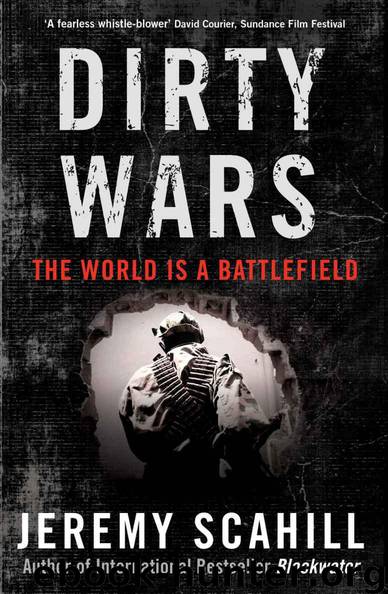
Author:Scahill, Jeremy [Scahill, Jeremy]
Language: eng
Format: mobi
Publisher: Profile Books
Published: 2013-05-08T23:00:00+00:00
37 Driving Anwar Awlaki to Hell
YEMEN, 2010—In early February 2010, AQAP leader Said Ali al Shihri, whom the Yemenis had claimed to have killed multiple times, released an audiotape. “We advise you, our people in the Peninsula, to prepare and carry your weapons and to defend your religion and yourselves and to join your mujahideen brothers,” he declared, adding that US “espionage planes,” presumably drones, had been killing women and children.
On March 14, the United States struck again. Air strikes hit Abyan in southern Yemen, killing two alleged AQAP operatives, including its southern chief, Jamil al Anbari. As it did after the al Majalah bombing, Yemen took credit for a US attack while Washington remained silent. AQAP leader Qasim al Rimi confirmed the deaths in an audio recording released soon after the strikes. “A US strike targeted our brother,” he declared. “The attack was carried out while our brother Jamil was making a phone call via the Internet.” As for Yemen’s claims to have carried out the strike, Rimi said, “This nonsense is similar to their allegations” in the December 2009 strikes. “May God disgrace lying and liars.” A few months later, AQAP would avenge the deaths by launching a brazen attack against a government security compound in Aden, killing eleven people. The claim of responsibility was signed: “Brigade of the martyr Jamil al-Anbari.”
A week after the March 14 strike, one of the key US officials running the Obama administration’s covert war in Yemen, Michael Vickers, accompanied then-undersecretary of defense for intelligence James Clapper for talks with President Saleh and other Yemeni officials. The US Embassy released a brief statement on the meeting, saying only that they were there “to discuss the ongoing counterterrorism cooperation” between the two countries and “to express the appreciation of the United States for Yemen’s continuing efforts to counter” AQAP. A month later, Vickers gave a closed-door briefing to the Senate Armed Services Committee on covert US action in Yemen and Somalia. An internal e-mail circulated within Vickers’s office at the time, and provided to me in confidence, acknowledged that “a task force operating in Yemen has helped Yemeni forces kill terrorism suspects, but it has also carried out unilateral operations,” adding: “The intelligence community, including the Defense Intelligence Agency and the Central Intelligence Agency vets the lists of targets and decides who needs to be captured for the purposes of intelligence collection, or who can be killed.”
While JSOC forces continued to operate inside Yemen, at times training Yemeni forces and, at others, conducting kinetic actions, the air strikes continued. In late May, General James “Hoss” Cartwright, vice chairman of the Joint Chiefs, briefed President Obama on a High Value Target that JSOC had a lock on. The president green-lit a strike. On May 24, a US missile hit a convoy of vehicles in the Marib Desert that “actionable intelligence” had concluded was heading to a meeting of al Qaeda operatives. The intelligence was only partly correct. The men inside the vehicle were not al
Download
This site does not store any files on its server. We only index and link to content provided by other sites. Please contact the content providers to delete copyright contents if any and email us, we'll remove relevant links or contents immediately.
The Radium Girls by Kate Moore(12096)
100 Deadly Skills by Clint Emerson(4974)
Rise and Kill First by Ronen Bergman(4840)
The Templars by Dan Jones(4739)
The Doomsday Machine by Daniel Ellsberg(4556)
The Rape of Nanking by Iris Chang(4265)
Killing England by Bill O'Reilly(4043)
Stalin by Stephen Kotkin(4008)
Hitler in Los Angeles by Steven J. Ross(3981)
12 Strong by Doug Stanton(3582)
Hitler's Monsters by Eric Kurlander(3388)
The Code Book by Simon Singh(3252)
Blood and Sand by Alex Von Tunzelmann(3242)
Darkest Hour by Anthony McCarten(3162)
The Art of War Visualized by Jessica Hagy(3046)
Hitler's Flying Saucers: A Guide to German Flying Discs of the Second World War by Stevens Henry(2777)
Babylon's Ark by Lawrence Anthony(2721)
Tobruk by Peter Fitzsimons(2560)
The Second World Wars by Victor Davis Hanson(2554)
